Coffee Without the Machine
** As an Amazon Associate we earn from qualifying purchases.
** A quiet moment, made one cup at a time.
Not every good cup of coffee needs a machine.
Sometimes all you want is a French press on the breakfast table, a strong moka coffee with warm milk, or a cold brew waiting in the refrigerator before the day begins. For others, making a pour-over is part of the enjoyment itself, a few quiet minutes spent making one cup exactly the way they like it.
These methods are all simple in principle, but they do not produce the same kind of coffee or suit the same kind of morning.
So rather than asking which manual brewer is best, it is more useful to think about the coffee you enjoy drinking and how much involvement you want in making it.
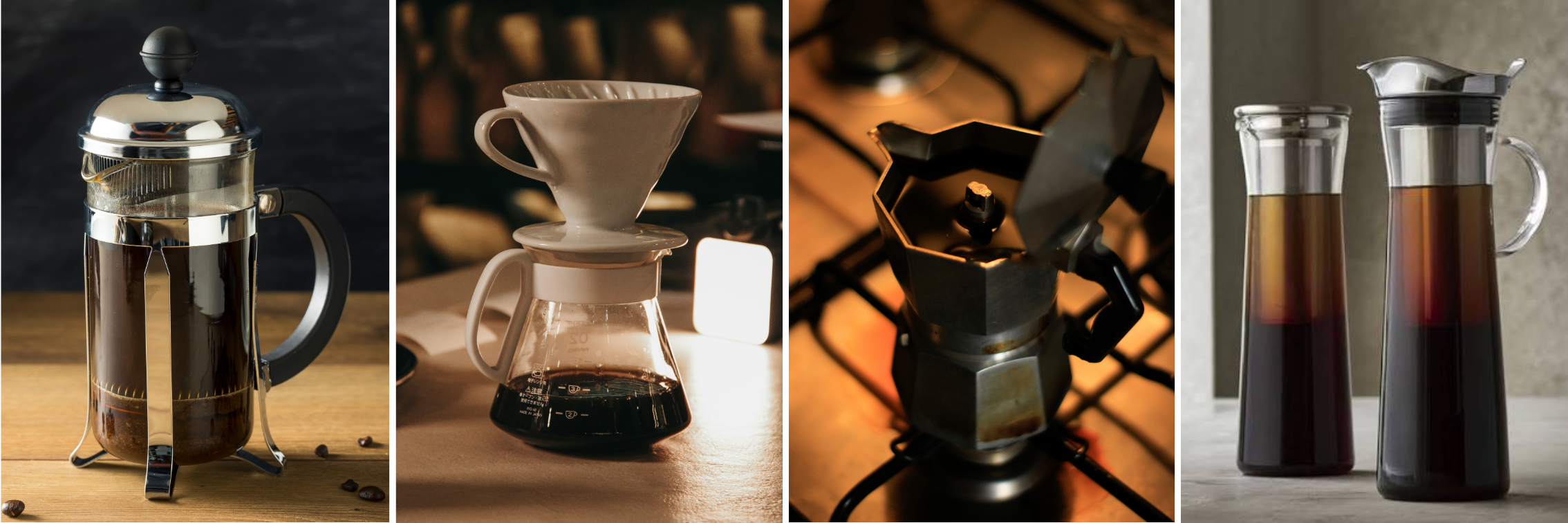
** Different brewing methods bring out different qualities in coffee, from the fuller body of a French press to the clarity of pour-over.
French Press for a Richer, Easygoing Cup
A French press is one of the easiest manual brewers to live with.
Add ground coffee, pour in hot water, leave it to brew and press the filter down. There is no careful pouring technique to learn and no machine taking up permanent counter space.
The coffee itself tends to feel fuller and richer because the metal filter allows more of the coffee's natural oils and very fine particles into the cup.
That makes it a good match for someone who likes a stronger-feeling coffee, particularly with a little milk or cream.
It is also convenient when you want more than one cup.
A larger presscan make enough for two people at breakfast or leave another cup ready for later, which is something many smaller pour-over brewers are not designed to do as easily.
The compromise is at the bottom of the cup.
A little sediment is normal, and cleaning wet grounds from the press is not quite as tidy as lifting out a paper filter. If you prefer coffee that looks very clear and tastes lighter, another method may suit you better.
But for a relaxed morning, particularly when coffee is being shared at the table, the French press asks very little and gives you plenty in return.
Pour-Over When Making the Cup Is Part of the Pleasure
Pour-over coffee suits a different kind of coffee drinker.
This is not usually the method you start when you want to walk away and do something else.
You are there for the few minutes it takes to make it.
Hot water is poured gradually over the ground coffee and passes through a filter into the cup or carafe below. The paper filter holds back much of the sediment and oil, producing a cleaner, lighter cup than a French press.
That can be especially enjoyable if you like trying different beans and noticing how one coffee tastes different from another.
There is also something appealing about the simplicity of the setup.
A dripper, filter, kettle and cup can be enough.
A gooseneck kettle makes it easier to control the pour, and measuring the coffee and water can help you make the cup more consistently, but you do not need to turn the morning into a science experiment unless that is something you enjoy.
Pour-over makes the most sense when you usually make one or two cups and do not mind giving the coffee a few minutes of your attention.
For someone rushing out the door, that may feel inconvenient.
For someone who enjoys those few minutes, it is part of the reason to choose it.
Moka Pot for Coffee With More Punch
The moka pot is for the person who looks at a regular mug of filter coffee and thinks, I want something stronger.
It makes a smaller, more concentrated coffee on the stovetop and works particularly well if you enjoy bold coffee on its own or use it as the base for a milk drink.
It is not espresso, even though the result is much stronger than ordinary filter coffee.
But that is also part of its appeal.
You can make a concentrated cup at home without buying an espresso machine, finding space for one or learning how to operate a more involved setup.
Warm some milk separately, froth it if you like, and the moka pot can become a very simple way to make your own version of a latte-style morning coffee.
It is also compact enough to disappear into a cupboard when it is not being used.
One thing to watch when buying is the size.
A moka pot advertised as three or six "cups" is referring to small servings, not three or six large mugs. Looking at the actual liquid capacity will give you a much better idea of how much coffee you are going to get.
And if you have an induction cooktop, check compatibility before buying. Not every traditional moka pot will work directly on induction.
For someone who wants strong coffee without a large machine on the counter, that little stovetop pot can do a surprisingly satisfying job.
Cold Brew for the Morning You Want Coffee Waiting
Cold brew requires almost no effort in the morning because the work happened the night before.
Ground coffee sits in cool water for several hours before being filtered. Once it is ready, it can stay chilled in the refrigerator for more than one serving.
That makes it particularly convenient for people who regularly drink iced coffee.
Open the refrigerator, pour it over ice, add water or milk if you prefer, and breakfast coffee is ready.
It can also be useful if mornings are rushed. A larger pitcher can prepare several servings at once, so you are not starting from scratch every day.
Cold brew tends to taste smoother and less sharply acidic than the same coffee prepared hot, although the beans themselves still make a difference to the flavour.
The trade-off is planning ahead.
If you suddenly decide at eight in the morning that you want cold brew, it is already too late to make today's batch.
But if cold coffee is something you drink regularly, making it the evening before can become an easy habit.
When choosing a pitcher, I would keep things simple. It needs a filter that is easy to remove and clean, enough capacity for the amount you normally drink, and a shape that does not take over the refrigerator shelf.
Bigger is not particularly useful if half the coffee is eventually poured away.
You Do Not Need the Same Brewer for Every Kind of Coffee
One of the nice things about manual coffee equipment is that it does not usually demand much space.
That means you do not necessarily have to choose one method forever.
Someone might use a French press when two people are having coffee at home, then reach for a moka pot when they want something stronger.
A pour-over can be the quiet weekend cup when there is time to enjoy making it.
Cold brew can sit in the refrigerator during warmer months when iced coffee becomes the default.
Unlike buying another large countertop appliance, adding a simple brewer does not have to reorganise the kitchen.
Still, there is no reason to collect every brewing method just because they exist.
Choose the ones that match the coffee you genuinely drink.
What Kind of Cup Are You Looking For?
The easiest way to choose between them is to forget the equipment for a moment and picture the coffee.
If you like it rich, full-bodied and easy to make in more than one serving, a French press is a natural place to start.
If you prefer a cleaner cup and enjoy spending a few minutes making it, pour-over gives you more involvement.
If your idea of a satisfying coffee is small, strong and perhaps topped with warm milk, the moka pot offers that without an espresso machine.
And if you want cold coffee already waiting when morning arrives, a pitcher of cold brew is difficult to beat.
None of these methods needs to turn coffee into a hobby.
Sometimes the pleasure is much simpler: choosing the brewer, making the cup and finding that it tastes exactly the way you hoped it would.
Explore Essentials